I am Dr. Marina Shurova, owner of MyDental in Lutz. I am writing this as a warning to fellow local small business owners, because I was recently targeted by a scam convincing enough to fool careful people, and I want you to recognize it before it costs you money. The most unsettling part was not a clever lie — it was the truth: nearly every fact in the “Wikipedia page” they built for me was accurate, and that is exactly what makes this so effective.
How the scam works, step by step
- The unsolicited pitch — sent through my own website. A “Sales Executive” named Effie Wells, from a company called Pro Online Profile (proonlineprofile.com), filled out the contact form on my own Contact Us page. Subject line: “Get A Wikipedia Page For Yourself Or For Your Company.” The pitch was flattering and stat-heavy — it claimed “Wiki links show up on the 1st page of Google 97% of the time” — and it is built to make you feel you have “arrived” and deserve one.
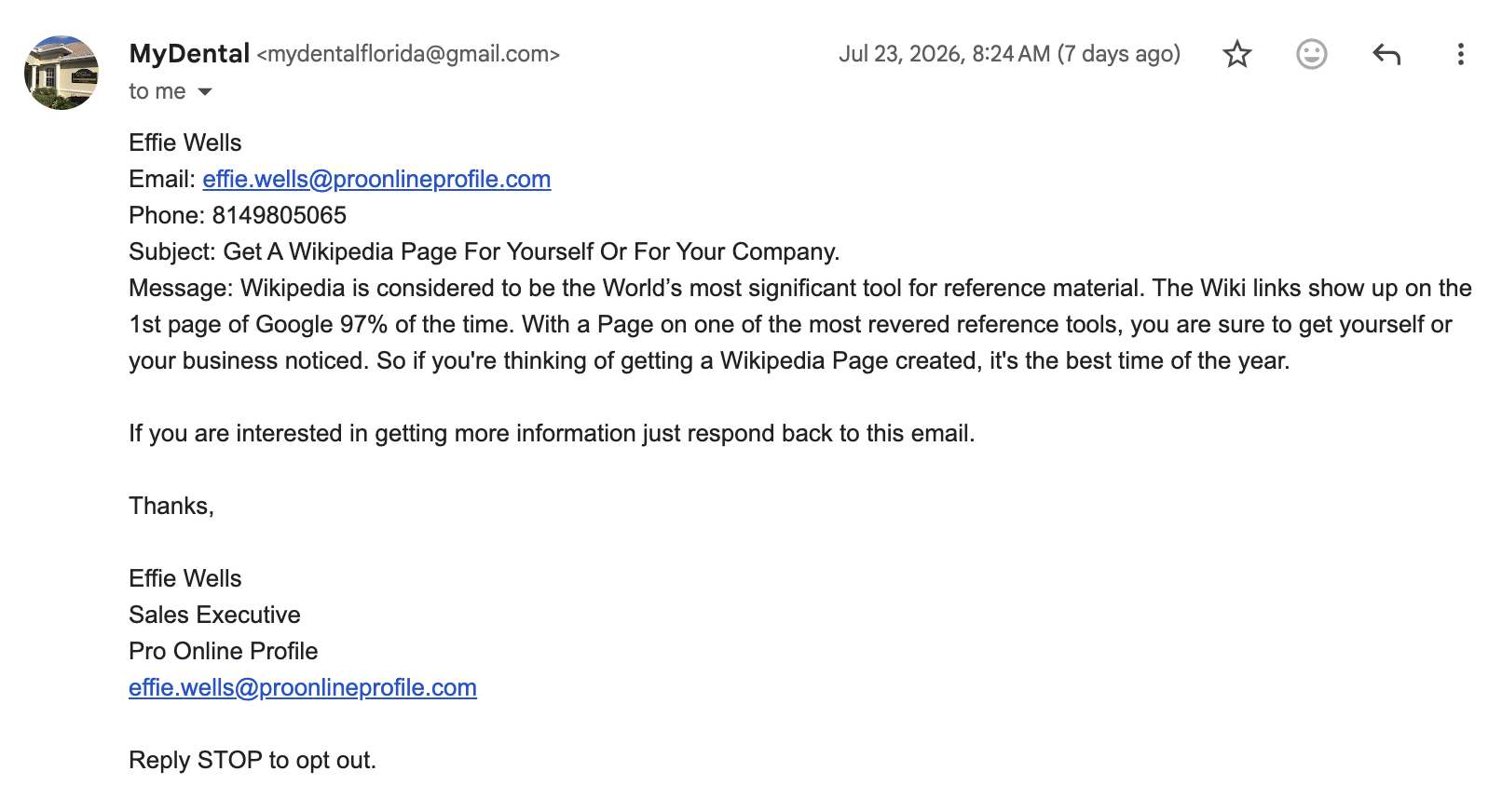
The pitch — submitted through my own website’s Contact Us form (Pro Online Profile / Effie Wells). 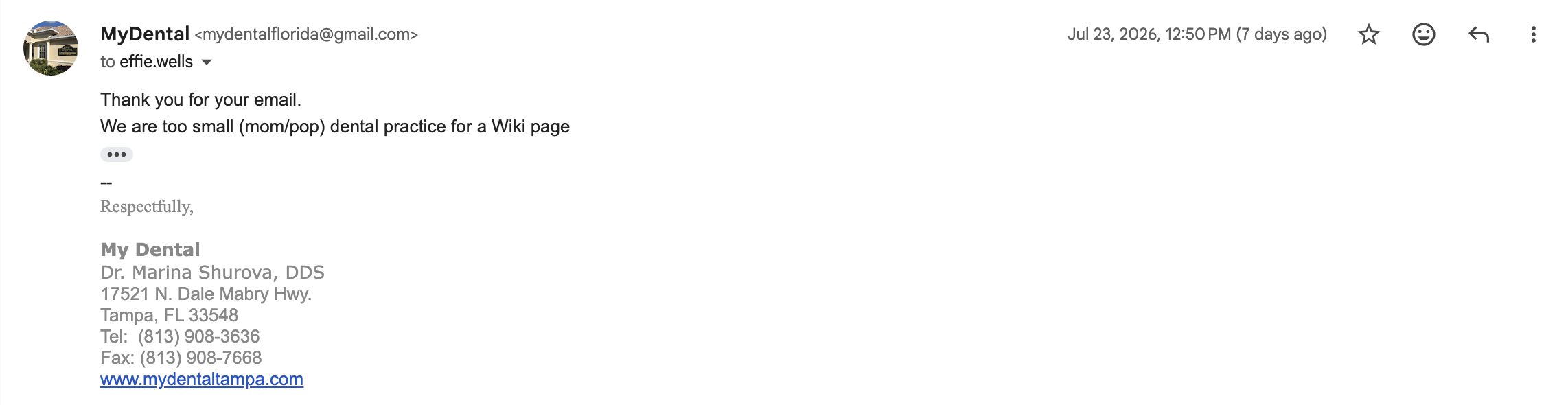
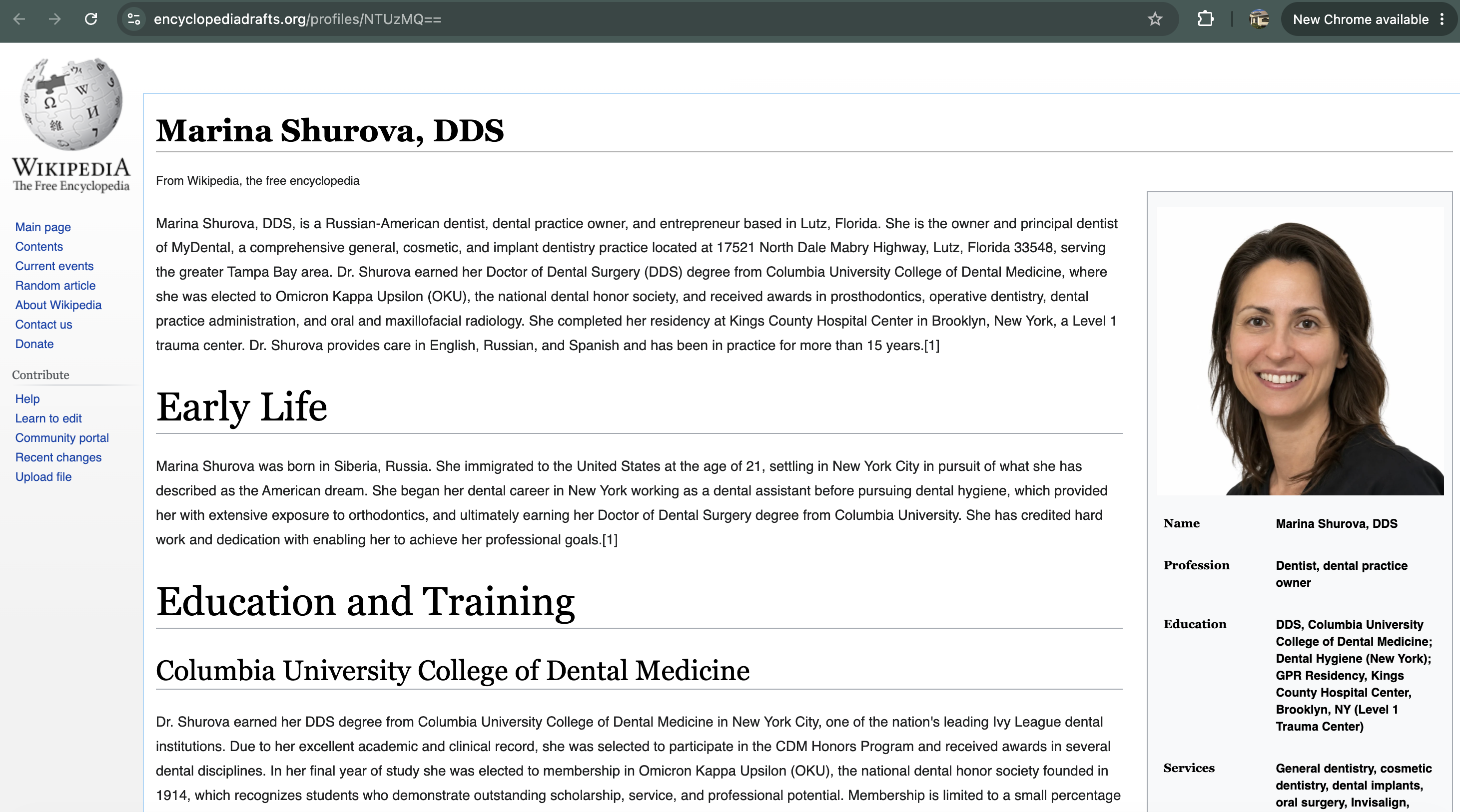
My reply: we are too small a practice for a Wikipedia page. - The free “draft.” After I replied, a second person, “Allen Young,” wrote that their “licensed Wikipedia Moderators have prepared an initial draft for you” — there is no such thing as a licensed Wikipedia moderator — and sent a link to a finished, professional-looking page titled “Marina Shurova, DDS | Wikipedia Drafts.” The catch: it was not on wikipedia.org. It was hosted on a look-alike site, encyclopediadrafts.org.
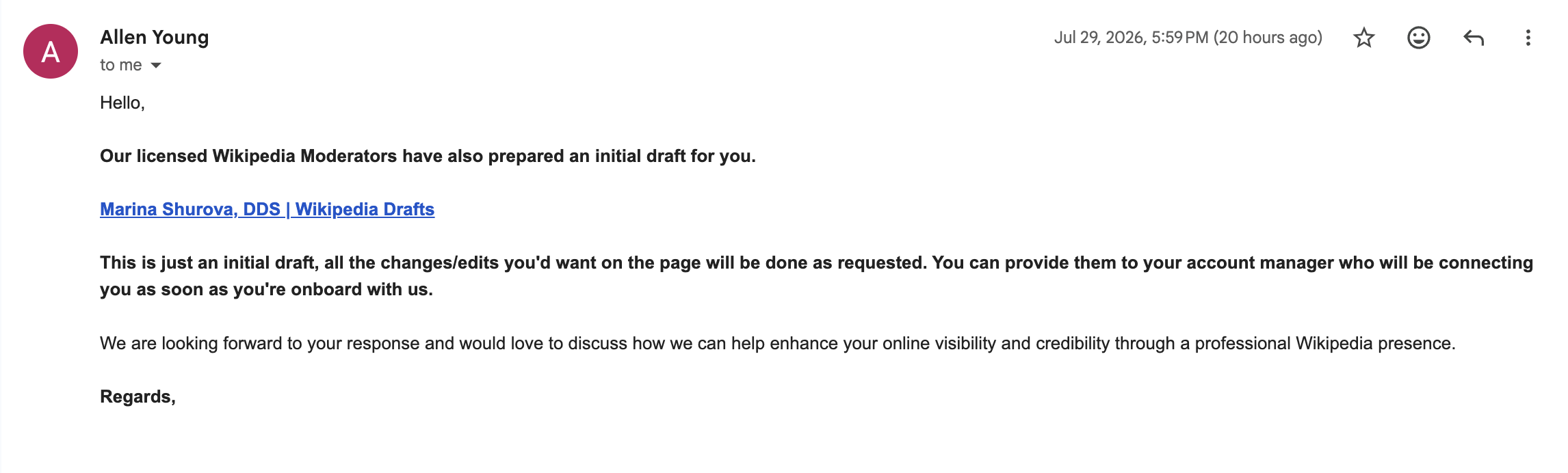
They followed up with a “draft” — claiming “licensed Wikipedia Moderators” prepared it. There is no such role. - The hook — the information was accurate. This is the part people underestimate. The draft was not full of obvious errors. They had done their homework. My real Columbia dental degree, my honor-society membership, my hospital residency, my correct address and services — all pulled straight from my website and LinkedIn, laid out like a genuine encyclopedia entry. Because the facts were right, nothing set off alarm bells. That accuracy is exactly why a busy owner might reach for a credit card.
- The close. When I asked the price, “Allen Young” said he would use an “employee voucher” to bring the “basic package” down to a one-time fee of $500, including “lifetime monitoring and maintenance.” Then came the ROI pitch — a Wikipedia profile “drives qualified traffic” and “builds trust and credibility” — and the nudge: “I’ll be happy to book your slots and get you the recognition you deserve.”
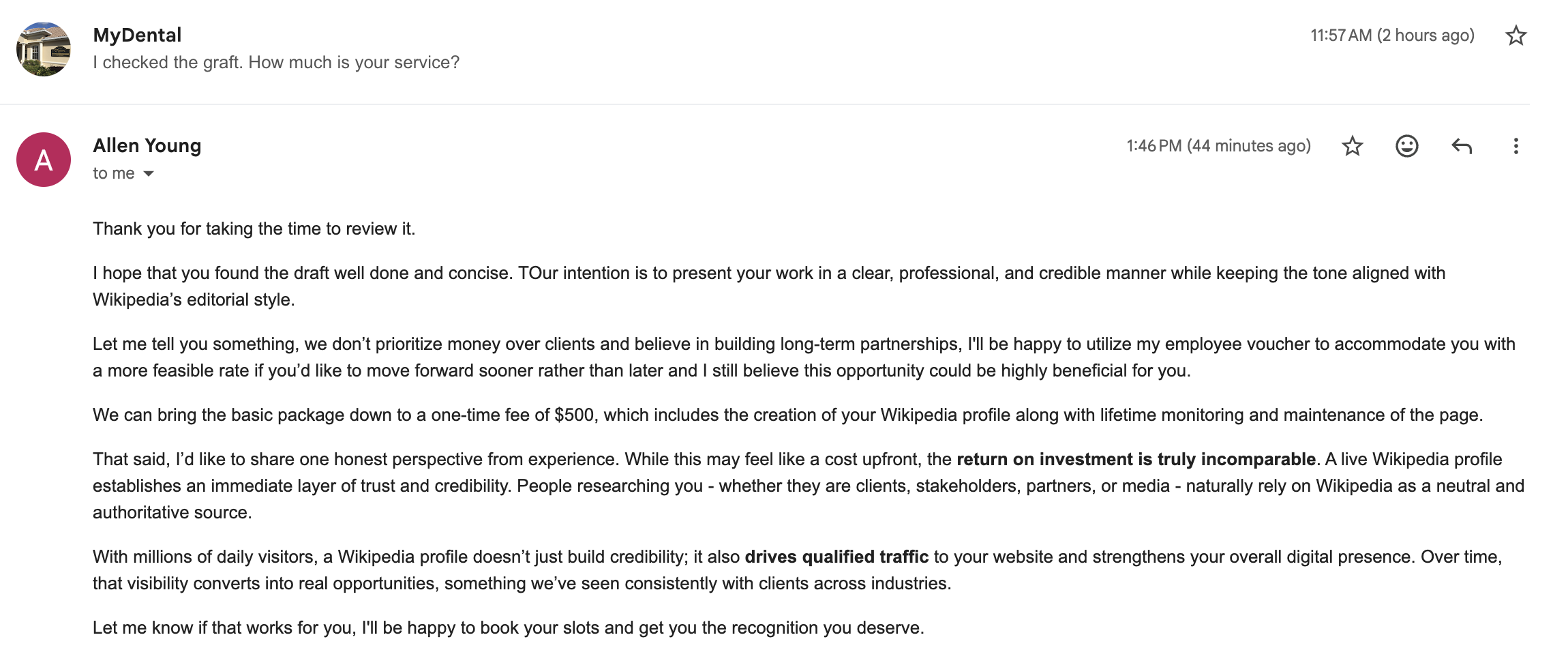
The close: a $500 one-time fee via an “employee voucher,” with “lifetime monitoring.”
Why it is a scam
- No one can sell you a Wikipedia page. Wikipedia is a free, volunteer-run encyclopedia. There is no sales department and no paid fast-track, and no one can guarantee your article is accepted or stays up. Wikipedia itself states that paid services promising to publish an article for you are scams.
- Most small businesses do not qualify, and that is fine. Wikipedia requires “significant coverage in reliable, independent sources.” A mom-and-pop practice like mine does not meet that bar, and we do not need to.
- The “test page” is a mockup, not a Wikipedia article. Anyone can build a page in Wikipedia’s visual style on their own website. If it is not live on wikipedia.org, it is a prop.
- Even if they publish something, editors will almost certainly remove it, and your money is gone.
How to tell it is not really Wikipedia (check it yourself)
The scary part of this scam is how real the page looks. Here is how to check any “Wikipedia page” in under a minute:
- Look at the web address. A real Wikipedia article or draft lives on en.wikipedia.org (a genuine draft looks like
en.wikipedia.org/wiki/Draft:Your_Name). The page they made for me was on encyclopediadrafts.org — a completely different website that simply named itself “Wikipedia Drafts.” - Check who owns the domain. Public registration records show encyclopediadrafts.org was registered in 2024 through a private registrar, on its own commercial servers. Real Wikipedia (wikipedia.org) has belonged to the Wikimedia Foundation since 2001 and runs on Wikimedia’s own servers. They are not the same organization.
- Look at the logo. Their page wore Wikipedia’s old globe puzzle-ball logo — but the real Wikipedia no longer uses that globe in its masthead (it now shows just the “WIKIPEDIA” wordmark). An outdated logo is a sign the page was built from an old template, not by Wikipedia.
- Do not be fooled by a Google search. If you Google their look-alike domain, Google may “correct” it to the general phrase “encyclopedia drafts” and show an AI summary describing the real Wikipedia draft system. That summary is about real Wikipedia, not the look-alike site — but because it lands on the same results page, it makes the look-alike site look official. It is not.
Real Wikipedia drafting is free, open, and happens on wikipedia.org. If a “draft” of you lives on any other website — especially one that later asks for payment to “publish” it — it is not Wikipedia.
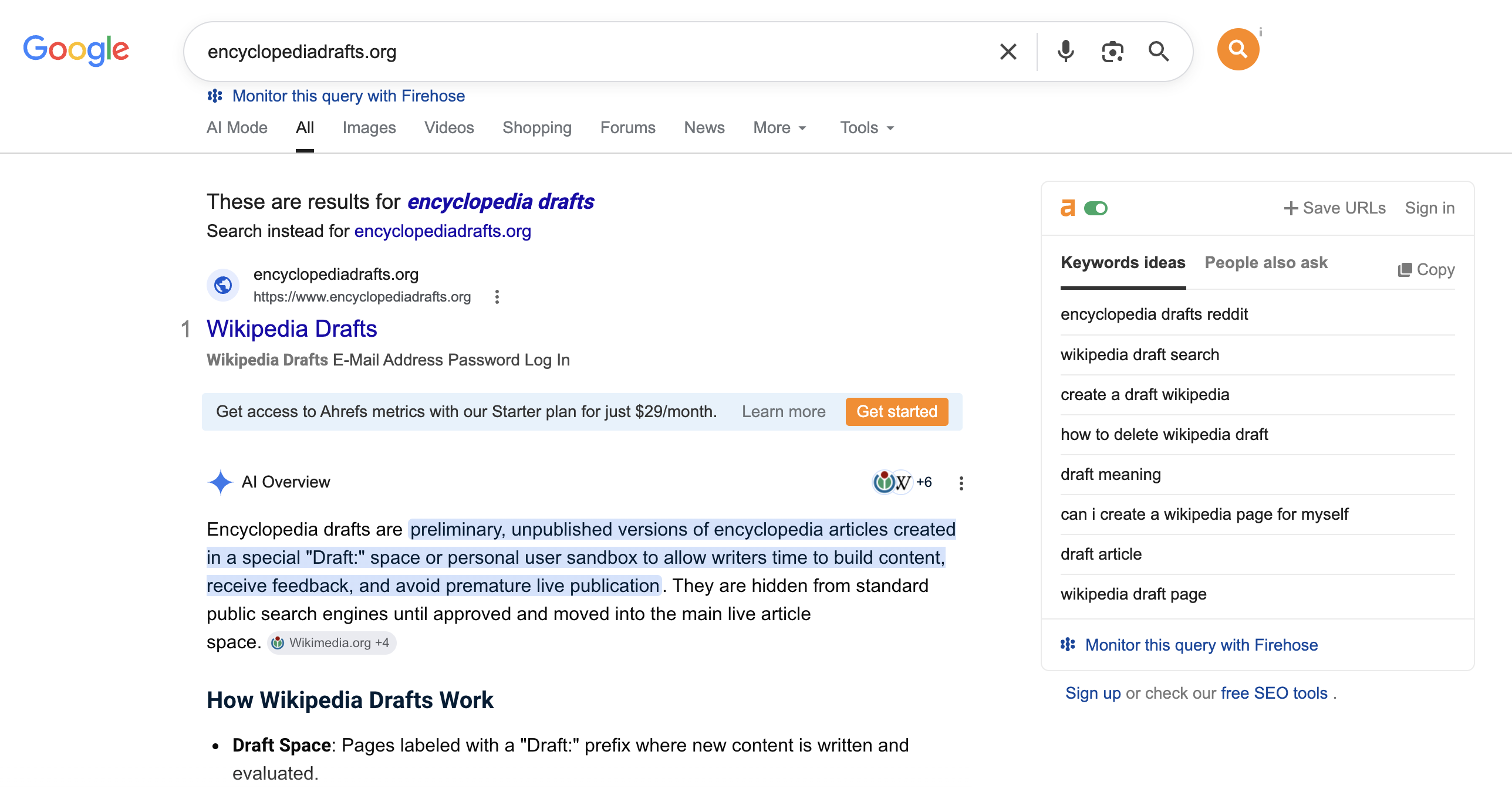
How did they even find me?
They did not single me out. Companies like this scrape public business data at scale, from directory listings, Google Business Profiles, LinkedIn, and association pages, then send the same mail-merged pitch to thousands of owners. Ironically, the more you do the honest work of building your local presence, the more visible you become to these scrapers. You were harvested, not chosen.
The most dangerous part: they got the facts right
You might picture a scam page full of obvious mistakes. Mine had none. Here is how the biography they built opened, word for word:
“Marina Shurova was born in Siberia, Russia. She immigrated to the United States at the age of 21, settling in New York City in pursuit of what she has described as the American dream.”
That is accurate — and so was the rest of it: my Columbia University dental degree, my Omicron Kappa Upsilon honor-society membership, my Kings County Hospital residency, my real address and services. They pulled it all from my website and LinkedIn and laid it out cleanly, like a real encyclopedia entry. That is precisely why this scam works. It does not read like a forgery — it reads like a flattering, correct, professional profile of you. And when every fact is right, it is easy to miss the one fact that is wrong: it is not on Wikipedia at all. I have preserved the full page here so you can judge it for yourself: a copy of the “Wikipedia Drafts” page they built for me. Look at the web address — it was encyclopediadrafts.org, not wikipedia.org. That is the whole trick.
They will almost certainly take that page down once they realize it has been exposed, so I have also saved a screenshot below as a permanent copy. Either way, it is not a real Wikipedia article, and I did not create or endorse it.
What I did, and what you should do
- I did not pay, and I stopped responding. Engaging only tells them you are a live target.
- If they email repeatedly, mark as spam and block rather than reply.
- Never send money or “article” fees for a Wikipedia page.
- If you genuinely qualified and wanted a page, the real path is free, through Wikipedia’s own volunteer help forums. Most local businesses will not qualify, and do not need it.
- A Wikipedia page does nothing for local search anyway. What actually helps customers find you is your Google Business Profile, honest reviews, and consistent listings.
Who contacted me, and the warning signs
The company that contacted me was Pro Online Profile (proonlineprofile.com) — first through a “Sales Executive” named Effie Wells, then a closer who signed as “Allen Young.” The page they built was hosted on a “Wikipedia Drafts” look-alike domain, encyclopediadrafts.org, not on wikipedia.org.
Red flags, in one list:
- An unsolicited offer to create a Wikipedia page for you — even one that arrives through your own website’s contact form.
- Official-sounding claims like “licensed Wikipedia moderators” (Wikipedia has none).
- A finished, flattering “draft” that is accurate but is not on wikipedia.org.
- A sudden “discount” — an “employee voucher” or limited-time rate — the moment you ask the price.
- ROI-and-urgency language: “qualified traffic,” “the recognition you deserve,” “book your slots.”
- Relentless follow-up the moment you show any interest.
If a company is pressuring you like this, trust your gut. It is a scam.
At MyDental, we care for Lutz and greater Tampa Bay families with general and cosmetic dentistry, dental implants, TMJ treatment, and same-day emergency care, and we believe in being straight with people, which is exactly why I wrote this. If we can ever help with your smile, get in touch anytime.
If this helped you, please share it with another local business owner. And if you have been targeted by something similar, I would like to hear about it.
Dr. Marina Shurova, MyDental, Lutz FL